

The New Institution
A critical fiction on the forms and possibilities of the art institution in the present.

We precede and exceed the institution. We refute and refuse the institution. We outlast and abandon the institution. We occupy and inherit the institution. We practice and perform the institution. We play the institution like an instrument. We break the institution like a law.
***
Out of the crises of our time come monsters of all kinds; perhaps out of these same crises may come new institutions appropriate for our lives.1
Not whitewashed, not whitewalled2, not patriarchal, not parochial. Not neoliberal, not capitalist, not market-based, not made to last. Not for the sake of art, not forsaking art. A new con-stitution for a new constituent3. A new institution formed from and for our time.
The new institution inaugurates another world. The new institution listens. The new institution refuses. The new institution confesses. The new institution conspires. The new institution is both guest and host. The new institution is understated. The new institution is stateless. The new institution is contingent. The new institution is contextual. The new institution is site-conditional4. The new institution is decolonial or, better, unsettled.5 The new institution is unstable and sustainable. The new institution is multiple and multiplying. The new institution is an attempt. The new institution is a dissent.
***
Let’s set this in a place – for the sake of specificity, St. Louis. Not “they,” but “us.”
We seed new futures out of our existing shells. We close. We go itinerant. We change our name. We reopen. We are an ensemble: all the parts of a thing taken together.6
We occupy abandoned buildings and empty lots as plein air workshops, laboratories for living, bottom-up squats. We form an artist-run land trust, a collectively managed commons that connects spaces like trees canopying.7 We enter high-rises along the riverfront and see something in their mirrored transparencies – a value in reflection, a reification of an anywhere institution. We ask for the keys and are given them. We gather in City Hall as a post-contemporary agora; a place where future publics form.8 We legislate, collectivize, advance. We tax ourselves to make our museums free.9 We play with policy as one picks up a chess set – infinite possibilities with finite pieces.
We own the streets. The streets own themselves.10 We enter the streets as collaborators. We wade into the river for material; we dredge the mainstream, looking for new channels as the water refinds its original path. The parks host alternative schools running through the summer.11 In inclement weather, the school moves to the back rooms of the museums. During these sessions students open stacked crates containing colonized pasts and presents and rewrite the provenances back to their original places. The objects of their studies are deaccessioned and reassessed, a collective collection.
We stitch together the suburbs as wayfinding flaneurs through the fissures of fractured municipalities.12 If the center cannot hold, we try on a municipalist approach, a movement towards multiple centers of influence. We open art spaces in our neighbors’ sheds, microcinemas in mid-century ranch homes, scent-based exhibitions in greenhouses, and underground clubs in the endless strip malls.
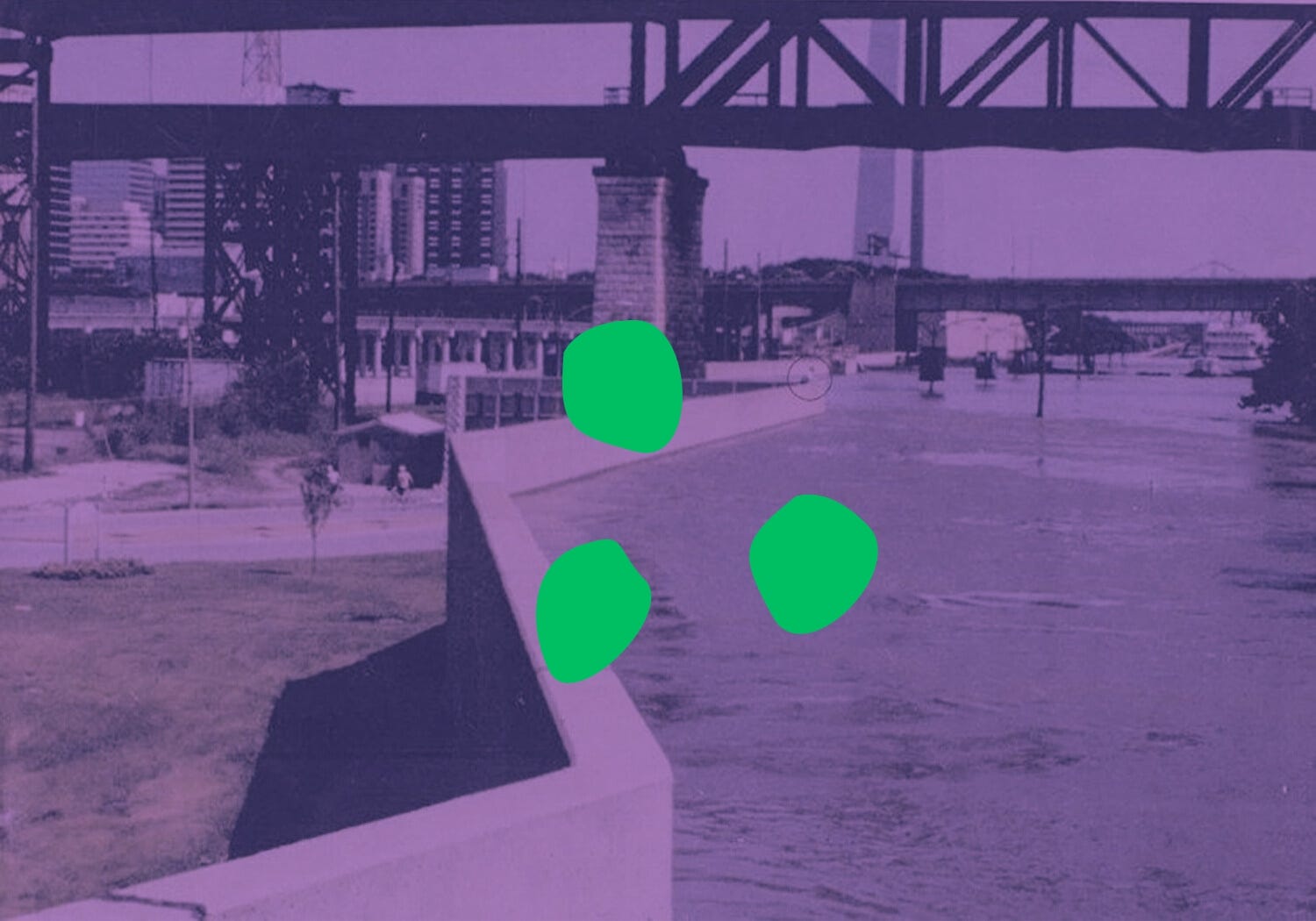
Barbershops, bakeries, taquerias and corner stores become sites for commissions, communal gathering spaces, durational performances, and ephemeral actions.13 Beauty supply stores double as art suppliers,14 the bookstores are bookended by print shops and publishers,15 and the home goods shops sell offset instructions for off-grid living. Barges run continuously on the Mississippi river from Minneapolis to New Orleans, transporting a dispersed Anthropocene alternative school along the route like downriver pollinators.16 The flood wall contains a litany of complaints, speculations, sketches, and blueprints for a new community. The ideas remain on view, constantly overwritten, an endless charrette that we understand may one day be underwater.17
Artists take over an empty steel mill, shuttered from tariffs and trade wars.18 A coop forms as artists with workers open a concert hall in its core and fabrication studios and shops around the outside. Residencies and fellowships are for the workers themselves, offering livable wages and employment options.19 The workers, with artists, merge unions to offer health care, political education, and housing.
The exhibition decarbonizes. The exhibition degrows. The exhibition returns the land, a rematriation.20 The exhibition returns the money, a reparation. The exhibition is a practice institution. The exhibition is a question - how do we want to live? The exhibition is one of many answers.
The museums are all free.21 The museums are run by women.22 The museums make no distinction between the community and the community. The museum opens a childcare cooperative for all cultural gatherings. The museums are sanctuaries for immigrants under siege. The museums protect the unprotected as they would their collections. The museums form an opposition party. The museums deaccession untrustworthy trustees. The museums perform the politics they present in their exhibitions. Pre-figurative painting becomes less abstract. We live into this image.
The artist spaces are sustained through a voluntary redistribution of donations from the largest spaces to the smallest. The artist spaces are at odds with each other. The artist spaces publish competing manifestos on future movements. The artist spaces run for office. The artist spaces multiply uncontrollably across the city. There is an art house in every neighborhood serving their neighbors’ needs.23 DIY curatorial classes meet in the kitchen, artists garden the front yard and give away the food at exchanges of ideas and objects. Artist-activist collectives collaborate on alternative wellness houses. They grow medicinal plants all over the city, locatable by map.24 They shelter anyone who needs it, a host of all who come. The sculpture garden feeds families.
This goes on for years, a deep ecology. They inherit and multiply their wildness. They build houses with unfinished terraces for others to occupy.25 They build root cellars and open-air orchards. They make victory gardens to outlast climate change. They shape a new American landscape.26 They make brick presses and rebuild their neighbor’s walls.27 As artist spaces age, they become elders, enabling the next wave to expand their visions unpredictably, ensuring they are exceeded. As an artist space closes, two more open in their wake.28
The critics care. The critics publish anywhere – in neighborhood newsletters and private listservs, in daily newspapers and on the AM radio airwaves, on posters at bus stops and wheat pastes beneath bridges.29 The critics are paid for this from a collective fund formed by art spaces and patrons to ensure work is documented, discussed and dissented.30 The critics show up at protests. The critics initiate the protests. The museum directors join. The new institution, as with the new artist, protests.31
These protests are welcomed into our halls, houses, and galleries. The protests are still unending because we all agree that they are necessary to know ourselves; that they expose areas of not-knowing; that they, in fact, save us. This is our greatest export and highest historic achievement. This is the foundation and future of the new institution.
***
This piece was first written in 2018 and lightly edited in 2025. It may read like a utopian fantasy, yet is in direct reference to dozens of actual projects in St. Louis and the surrounding region (linked in footnotes where possible), many of which I was directly involved in or witness to in some form. They have often been ephemeral, and some never found wider publics, but the point remains: the world we want is here, if we support it wherever we see it and oppose the worlds we don’t want. We can live into it.
Referencing Gramsci’s concept of the interregnum, which Sarrita Hunn and I often used to frame our work with Temporary Art Review (2011-19).
Aruna D’Souza’s formational book Whitewalling opens in St. Louis around protests of Kelly Walker’s 2016 exhibition at the Contemporary Art Museum, which set off a template for institutional boycotts and protests globally that are ongoing.
The prefix con- appears throughout my writing, meaning “together” or “with” as another way to reframe the insular institution.
Drawn from Robert Irwin’s “Towards a Conditional Art” defined as distinct as site-specific in that an artwork (or institution, in my case) takes its cues from all of its surroundings - how a site is entered and exited, its environment, its social conditions, and so on.
See Counterpublic 2023 curators New Red Order’s “Never Settle”
“All the parts of a thing, taken together” is one definition of ensemble, which we use to describe our curatorial approach for Counterpublic.
This was a proposed project while I was at The Luminary, and also references the STL Art Place Initiative and other land trusts in St. Louis and elsewhere.
Referencing both Citizen Artists STL and the many artists and musicians who ran for office (and often won) and the political movements that bubbled up following the Ferguson Uprising in St. Louis.
St. Louis was the first US city to vote on a progressive tax to make its cultural institutions free in 1972.
A US English project organized by Brea Youngblood and I deeded a street to itself in South St. Louis.
Referencing the Chautauqua Art Lab and numerous residency projects organized by Sarrita Hunn.
Referencing Gavin Kroeber’s Laboratory for Suburbia, organized with The Luminary.
Referencing Counterpublic 2019.
Katherine Simóne Reynolds’s Mane N’ Tail exhibition at The Luminary.
Referencing numerous projects in St. Louis and beyond, including KNOW/HOW Books & Print.
Anthropocene River School, which intersected in St. Louis in 2019 (and continues)
The Mississippi Flood Wall in Downtown St. Louis is the longest mural in the world. Paint Louis brings artists together each year to overwrite the last, though it is always open for people to repaint.
Though inspired by GCADD, an incredible set of artist spaces and projects adjacent to a steel mill in Granite City outside of St. Louis, this is more of a wishful fabrication.
This relates to Bread & Roses Missouri, who organize and produce arts and humanities events, exhibits, and workshops for and about workers and their families.
This section all refers to Counterpublic, past and future projects, including the rematriation of Sugarloaf Mound with the Osage Nation.
See footnote #9 above - all major museums in St. Louis are free through a public tax (and very high rates of donations city-wide).
The link is no longer online, but this was the focus of a roundtable I organized for Art in America. Uniquely, the major art museums of St. Louis are all led by female directors, including the St. Louis Art Museum, Contemporary Art Museum, Pulitzer Arts Foundation, Laumeier Sculpture Park, and the Mildred Lane Kemper Art Museum.
There are a number of people and collectives this is inspired by, but I would specifically mention Dail Chambers and her Coahoma Orchards project.
Wild Building has been a metaphor for generational work within artist spaces for many years.
Studio Land Art’s founder, Chris Carl (also involved at GCADD above), used to use the phrase “New American Landscapes” as a tongue-in-cheek reference to his work and the New American Paintings magazine.
Missouri-based Open Source Ecology has been recreated open source versions of foundational machines of the industrial revolution, including a completed brick press.
This was the premise of my Creative Capital/Warhol Foundation Arts Writers grant in which I published art criticism for a year through direct mailers, on 4chan and Reddit, through an internet ad plugin and more.
This was one proposal I first put forward in a presentation and essay, Dependent Publications: Art Publishing Presents and Futures written for The Chart’s Anthology.
See again: The Luminary’s manifesto, itself inspired by Tristan Tzara’s “Dada Manifesto 1918” in which he proposed that “the new artist protests.”